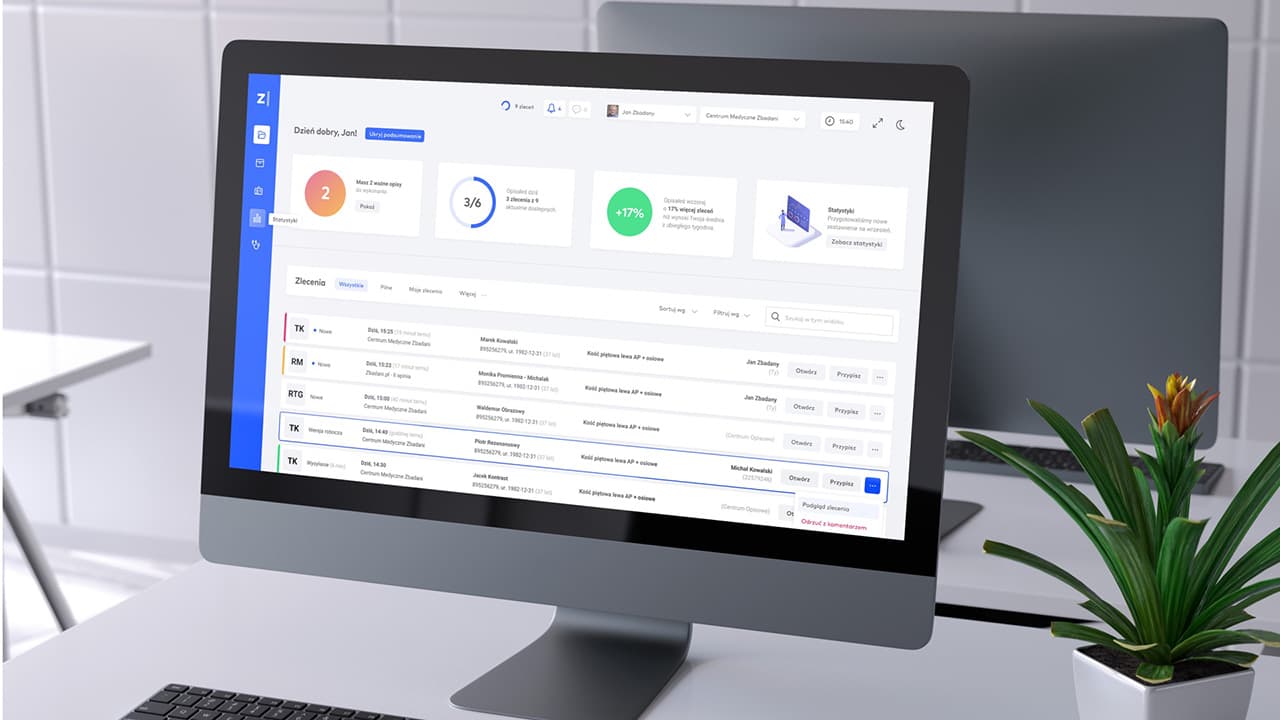


Tests of X-ray equipment and nuclear medicine devices
Basic, acceptance and specialist tests for medical X-ray and nuclear medicine devices in an accredited research laboratory.

Scope of activity
Complete range of tests in the field (accredited):
- general radiology,
- computed tomography,
- mammography,
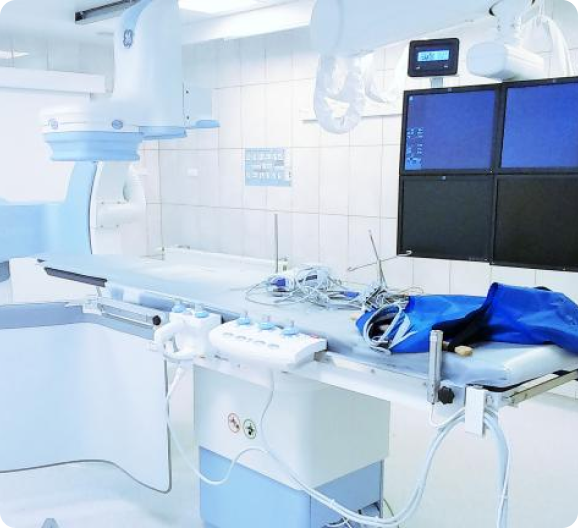
- angiography,
- fluoroscopy,
- dentistry,
- nuclear medicine.
Additional services (non-accredited):
- training in performing basic tests in mammography, angiography, general radiography, fluoroscopy , computed tomography, dentistry,
- dosimetric measurements (measurements of the effectiveness of permanent shields and measurements of the dose rate distribution around the X-ray device),
- monitor calibration (BARCO, EIZO),
- sale of phantoms and dosimeters for performing basic tests.
10 reasons why it is worth doing X-ray tests in our laboratory:
1. The highest quality in Poland
We are accredited by the Polish Centre for Accreditation, which proves the highest quality of the tests we carry out on X-ray equipment and nuclear medicine devices.
Our management system meets the requirements of the PN-EN ISO/IEC 17025 standard.
The research laboratory is accredited by PCA, no. AB 703 (pdf certificate, scope of accreditation).
We hold valid calibration certificates for our measurement equipment. Our equipment is manufactured by internationally renowned companies (WELLHOFER, RAYSAFE, PEHAMED, GAMMEX, RTI).
2. Over 20 years of experience
We have been performing X-ray tests since 2004. Over 2,500 tests performed annually by our measurement teams create the conditions for accumulating experience, allowing us to continuously improve the quality of our services.
3. Over 1,000 satisfied customers
Over 1,000 clients have already trusted us. Our expertise is based on solutions verified worldwide. The company’s strict specialization, the experience and competence of its employees, and its policy ensure the highest quality of services and customer relations.
4. Security
We have $5 Million in liability insurance and a highly qualified staff with many years of experience (engineers and specialists with master’s degrees in medical physics and/or physics).
5. Efficient operation throughout Poland
We operate quickly, accurately, and are flexible. Our measurement teams are located nationwide, ensuring a short response time. We deliver test reports within 14 days (or immediately upon request), also signed with a qualified electronic signature.
6. Financial benefits
We offer free technical consultations and a certificate of X-ray testing with information that it was performed by an accredited laboratory.
7. No hidden costs
The laboratory does not charge for travel, accommodation or other additional costs.
8. Flexible payment terms
We respect the requirement of economy, so when you decide to start working with us, we are able to adjust the payment deadline to your needs.
9. Ongoing cooperation with leading manufacturers of X-ray equipment
Our ongoing, highly successful collaboration with service technicians from leading X-ray equipment manufacturers (Siemens, Philips, Shim-Med , GE, and others) in the field of acceptance testing helps avoid misunderstandings regarding equipment operation, additional costs, and time loss for the facility. Our extensive experience means that we generally do not require service personnel to perform tests.
10. Continuous development – implementation of the training plan
All employees are obliged to continuously improve their qualifications and level of knowledge in order to perform their work in a more conscious manner (also thanks to experience).
What is accreditation?
Accreditation should be understood as formal recognition by an authorized accreditation body of the competences of organizations operating in the field of conformity assessment, i.e. certification bodies, inspection bodies or laboratories, to perform specific activities.
What are the benefits of accreditation for medical facilities?
- High quality of products and services and competence of staff;
- Reliability of product certification results;
- Reliable and precise analysis and research results in areas related to safety, health and the environment (e.g. medical analyses, mechanical tests, chemical tests)
Improving the quality of our services
The measurement laboratory employs an experienced team of top-tier specialists. By maintaining high standards and continually improving our qualifications, we ensure:
- measurement traceability – the laboratory must prove that the equipment used is calibrated and its readings are correct;
- Validation of measurement methods – assurance that the measurement methodology is consistent with recognized measurement methods contained in standards and guidelines. This means that the customer receives exactly the product they, more or less consciously, expect: reliable measurement results;
- qualified personnel – each authorized, employed person must meet strictly defined criteria to be allowed to perform measurements;
- implementation of the training plan – all employees are obliged to continuously improve their qualifications and level of knowledge in order to perform their work in a more conscious manner (also thanks to experience).
Accredited laboratory - what does it mean?
PCA auditors and the Technical Committee within its structure assess:
- scientific and technical competences of an accredited laboratory,
- development of measurement methods,
- supervision of equipment and documents,
- level of customer service (including customer satisfaction).
The goal of an accredited company is to continually improve document management processes and maintain an appropriate level of technical and scientific knowledge. The experience gained by employees in Europe and around the world allows them to be sensitive and aware of potential discrepancies in the operation of X-ray equipment. Achieving these goals requires continuous investment in courses and training, including international training. This provides clients with the assurance that measurement results will reflect the actual condition of the equipment they use. Consequently, this ensures the safety of patients’ health and lives.
Frequently asked questions
-
What are basic tests?
Basic tests aim to ensure the accuracy, correctness, and repeatability of diagnostic procedures. They are, therefore, an essential element of the quality management system in X-ray diagnostics. Basic tests should be performed by healthcare facility employees authorized to operate radiological equipment.
-
What are acceptance tests?
Radiological equipment undergoing significant repairs and newly installed equipment are subject to acceptance tests.
Legal basis: Act of 29 November 2000 – Atomic Law (consolidated text: Journal of Laws of 2021, item 1941 and of 2022, item 974) and Regulation of the Health Minister of 12 December 2022 (consolidated text: Journal of Laws of 2022, item 2759) on operational tests of radiological devices and auxiliary devices.
-
What are specialized tests?
Specialized tests are a set of complex physical measurements designed to verify the current condition of a radiological device in terms of safety and proper operation. The tolerance ranges for the physical parameters tested are precisely defined in a regulation issued by the Health Minister.
Legal basis: Act of 29 November 2000 – Atomic Law (consolidated text: Journal of Laws of 2021, item 1941 and of 2022, item 974) and Regulation of the Minister of Health of 12 December 2022 (consolidated text: Journal of Laws of 2022, item 2759) on operational tests of radiological devices and auxiliary devices.
-
How often should a specialist test be performed?
Specialized tests of X-ray and nuclear medicine equipment must be performed at least once every 12 months, and for intraoral dental equipment at least once every 24 months. Tests of descriptive and review monitors must be performed at least once every 12 months.
Legal basis: Act of 29 November 2000 – Atomic Law (consolidated text: Journal of Laws of 2021, item 1941 and of 2022, item 974) and Regulation of the Minister of Health of 12 December 2022 (consolidated text: Journal of Laws of 2022, item 2759) on operational tests of radiological devices and auxiliary devices.
-
How to prepare for the specialist test?
The following must be ensured:
- access to the technical documentation of the device,
- presence of a person authorized to operate the devices
- X-ray equipment and nuclear medicine devices,
- the option of using consumables – e.g. cassettes and X-ray films,
- reports from previous tests
- provide the person performing the tests on your behalf with an individual dosimeter and, after obtaining the dose reading, make an appropriate entry in the individual dosimetric passport of the Employee performing the tests (Basis: Regulation of the Council of Ministers of 30 November 2020 on the protection against ionizing radiation of external workers exposed while working in controlled or supervised areas (Journal of Laws of 2020, item 2313 )).
-
Who is authorized to perform specialized tests?
Specialized tests can only be performed by companies that have PCA accreditation.
What are the consequences of not testing X-ray and nuclear medicine equipment?
The control system, which is designed to verify the timely performance of specialist tests by healthcare units, consists of two elements:
- Supervision of the State Sanitary Inspectorate,
- Internal (head of the health care unit) and external (provincial consultant) clinical audits.
In both elements of this system, audit teams pay particular attention to checking the regularity of operational tests, which include specialist tests and basic tests.
Deficiencies in the quality management system documentation (e.g. lack of a valid specialist test report) found during an inspection may result in the withdrawal of consent to provide services.
The closure of an X-ray and/or nuclear medicine facility due to failure to meet legal requirements is not the only possible negative consequence for healthcare facilities. Patients who consider themselves injured may file civil lawsuits seeking compensation. Healthcare facilities that failed to meet statutory requirements regarding the use of ionizing radiation for medical purposes may then suffer significant financial losses.
-
Where can I find information about the requirements of a quality management system in X-ray diagnostics and nuclear medicine?
All information related to the required tests, necessary documentation and division of responsibilities is contained in the Act of 29 November 2000 – Atomic Law (consolidated text: Journal of Laws of 2021, item 1941 and of 2022, item 974) and the Regulation of the Minister of Health of 12 December 2022 (consolidated text: Journal of Laws of 2022, item 2759) on operational tests of radiological devices and auxiliary devices.
Information regarding the obligation of having individual dosimetric passports and providing dosimetry to external employees working in controlled or supervised areas is contained in:
Regulation of the Council of Ministers of 30 November 2020 on the protection against ionizing radiation of external workers exposed while working in controlled or supervised areas (Journal of Laws of 2020, item 2313 )
Additionally, it is on the website of the National Atomic Energy Agency.